How Outset’s Digital Twins Work: One Real Person, a Confidence Score, and an MCP That Writes
Research Twitter has two settled opinions about AI participants. Either synthetic users are the future of qual and the panel is dead, or it is snake oil with a persona prompt on top. Outset shipped Digital Twins on August 26 and an MCP that writes back into the product on May 27, and their logo wall has FanDuel, HubSpot, Indeed and Coinbase on it.
I want to see how they built it.
One thing up front. Outset is enterprise. Every button on the site says Book a demo, there’s no trial or free tier, and nothing to poke at without a call. I didn’t request the demo. So this one is a study from the outside: their Digital Twins page, the changelog, three blog posts and a couple of third-party guides. Where I write “their blog says” or “the page says”, that is the whole source. I have never seen the inside of an account.
What is a twin, in their words?
The Digital Twins page opens with the promise: “directional answers in minutes, validated against the real person behind them”. Every twin starts from one human. You recruit a custom audience, each person sits a long “Grounding Interview”, and the twin is trained on that transcript. Follow-up interviews keep it current as the person changes their mind.
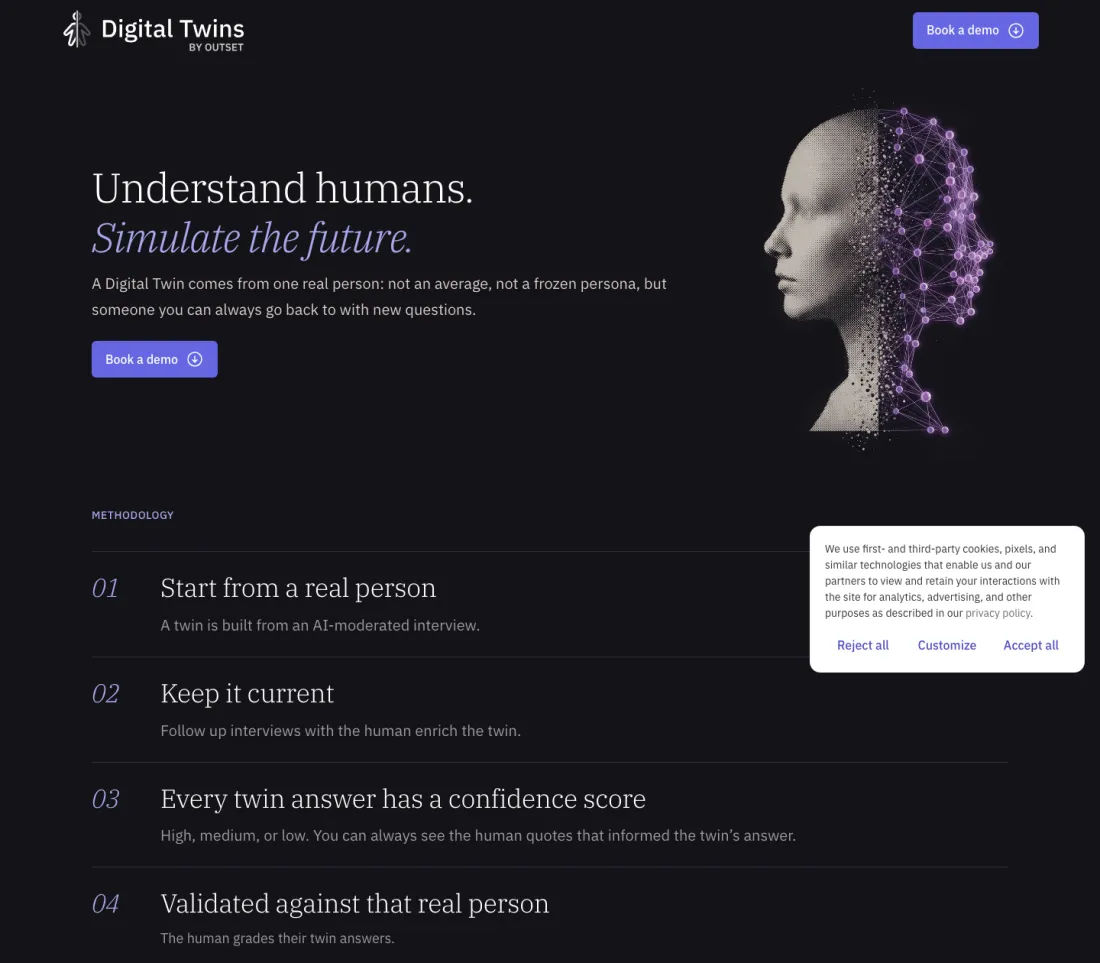
The thing on screen I kept coming back to is the confidence score. Each twin answer carries High, medium or low, and the page says “you can always see the human quotes that informed the twin’s answer”. Then the human grades their own twin. A participant reads what a model said in their name and marks it.
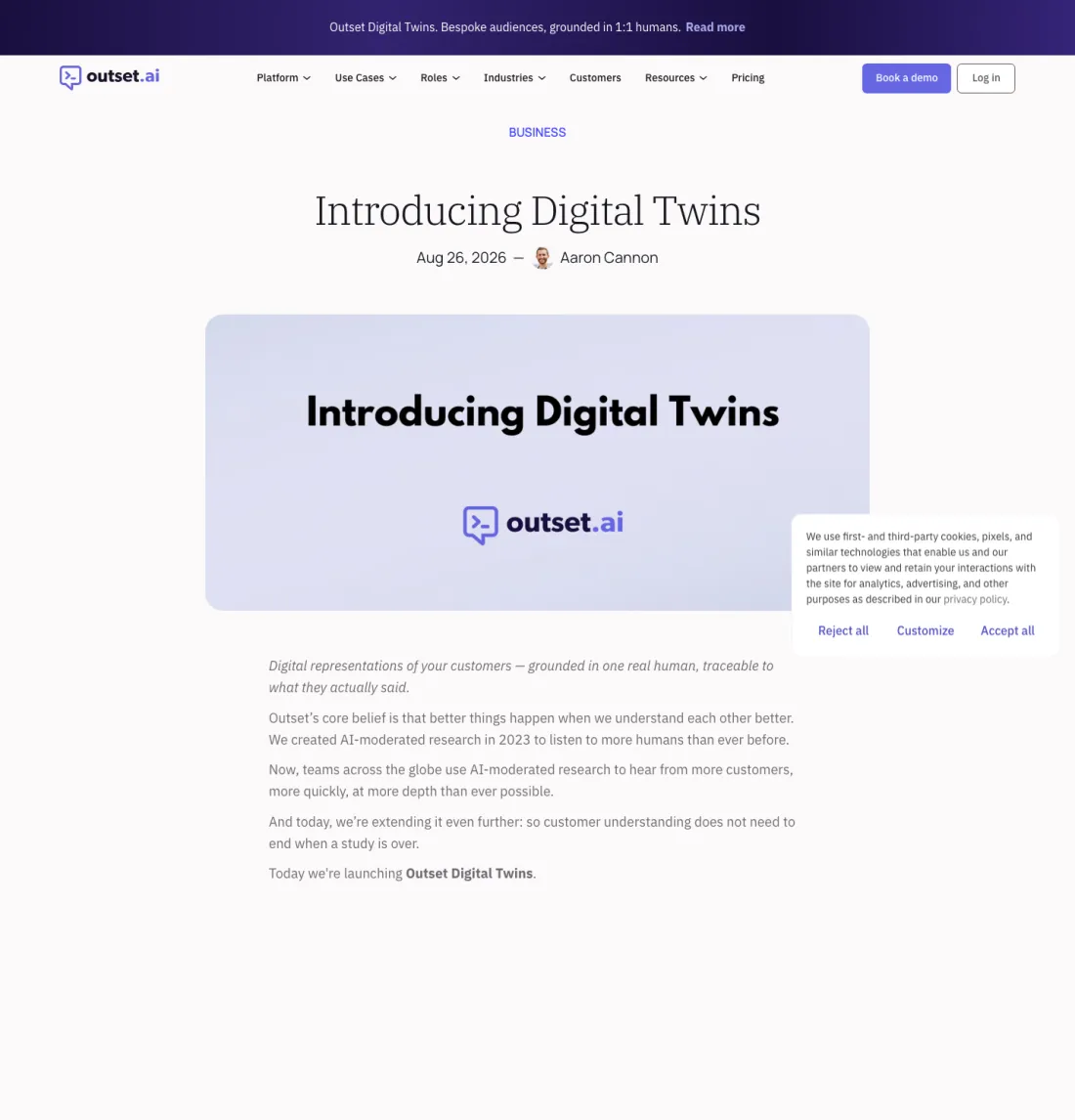
The launch post on their blog (August 26) lays out five steps: recruit, ground, train a persona core on “how someone reasons, not just what they answer”, blind-test by holding out training questions and comparing the twin’s answers to the real person’s, then re-interview periodically.
Credit where it’s due. A synthetic participant is the least trustworthy thing anyone sells in digital twin user research, and they put the source quotes under every answer. The twin can still be wrong, but the quotes it was wrong from are right there. The page also frames twins as a way to find the “contested questions” worth fielding with real people. Triage for the human study. Whether buyers use it that way I can’t tell from outside.
How does the interviewer decide to push? The twins are built on top of the interview product, so this matters. There’s a blog post titled “What actually happens in an AI-moderated interview”, and it’s the most specific thing on the site.
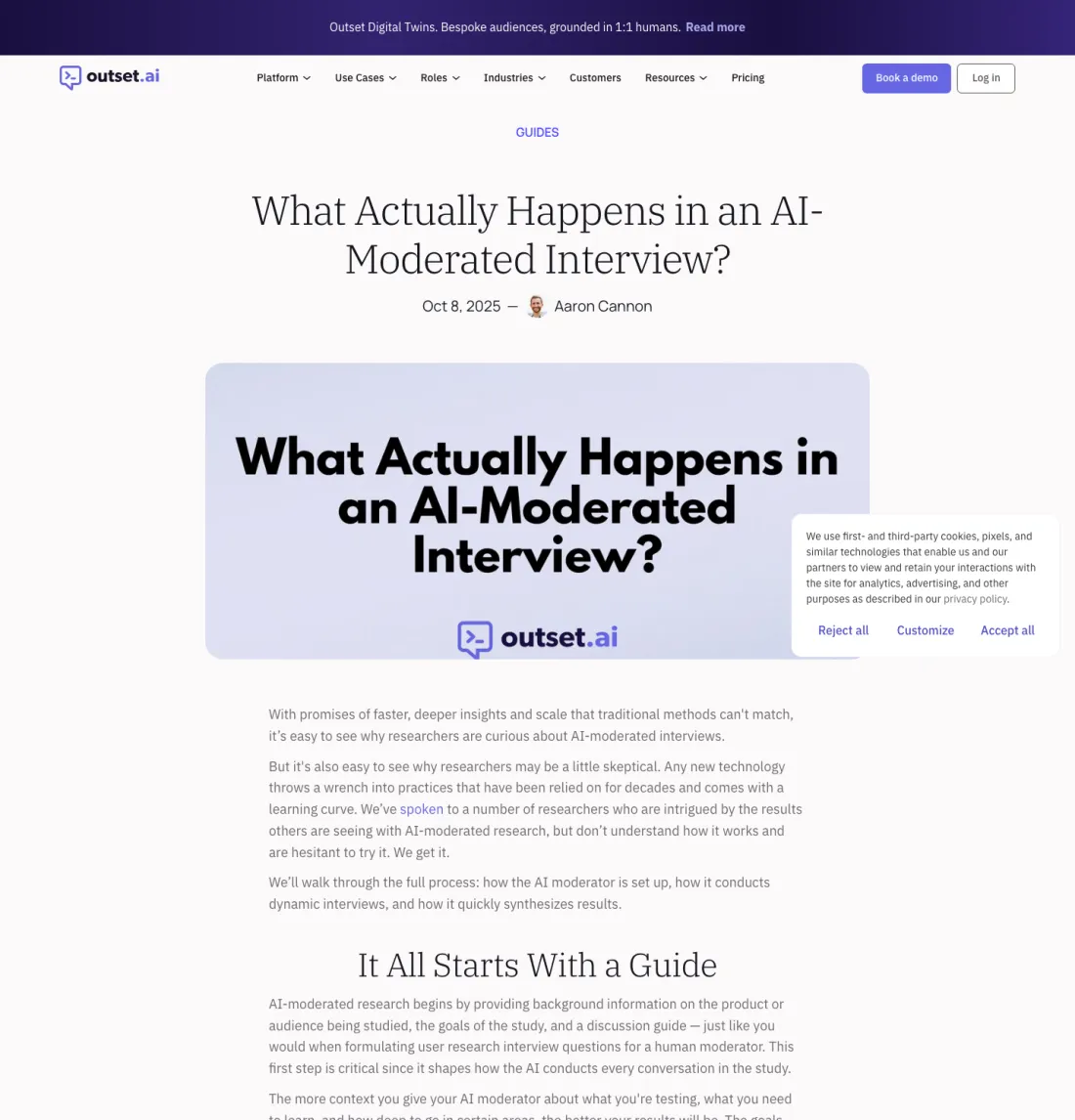
Follow-ups fire on linguistic cues: vagueness, sentiment, enthusiasm level and hedging language, with “maybe” and “I’m not really sure” given as the examples. The post says follow-ups are “grounded in researcher-configured instructions, not improvisation”, and that the moderator “doesn’t evolve independently during research, preserving data validity”. So the model is not learning from participant 12 and asking participant 13 something different. Same interviewer for everyone.
They also gave the depth setting a name. The interviews page calls it “Abyss mode”, up to 10 smart follow-ups per question. I like that a lot more than a hidden prompt. A researcher can write “Abyss mode on question 4” in a brief and everyone knows what it means. Interviews run in video, voice, voice-to-voice or text, in over 40 languages at once.
What does the changelog say?
The most honest page on the site is the changelog (they call it the changeblog). 38 dated entries, each with a thumbnail and a one-noun title. No marketing voice anywhere on it.
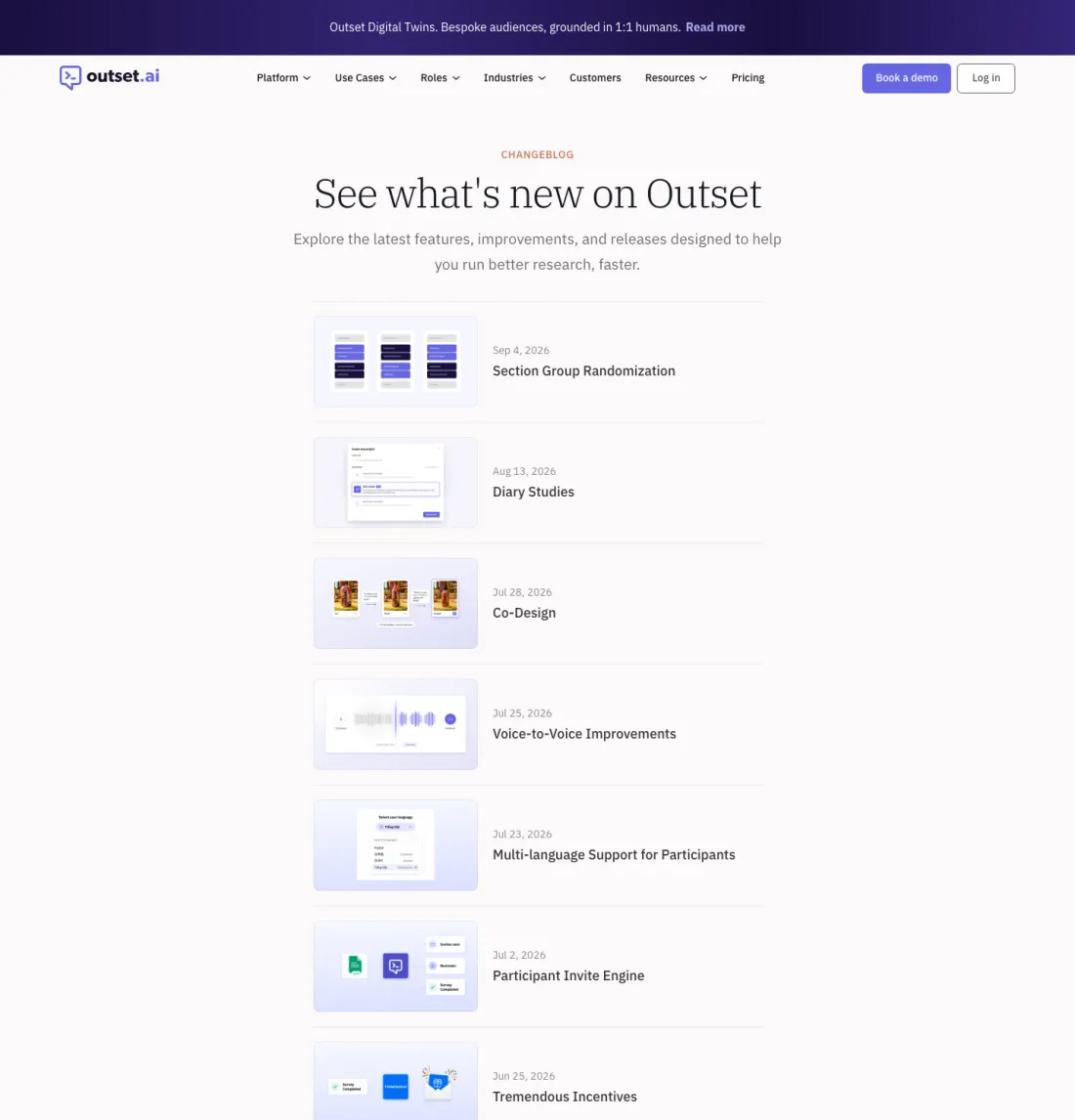
Read it top to bottom and the year splits in two. The first half of 2026 is all screening and security: AI Quality Screening on Jan 7, a Consent Template Library on Jun 8, MFA on Jun 10, Low Quality Response Screening on Jun 17, Auto-flag PII and SPII on Jun 22. June alone has 11 entries. Then the second half switches to new modes: Co-Design on Jul 28, Diary Studies on Aug 13, Digital Twins on Aug 26 (that one is a blog post, it isn’t in the changeblog), Section Group Randomization on Sep 4.
That order makes sense to me. You ship MFA and PII flagging before you ship a product that speaks as your participants. I’m reading that into it, but the dates line up.
What does the MCP do?
The Outset Agent post from May 27 announces a remote MCP at api.outset.ai/mcp. OAuth 2.1 with PKCE and dynamic client registration, nothing to install, and the clients listed are Claude, ChatGPT, Cursor, Figma, Notion, Glean and Microsoft Copilot.
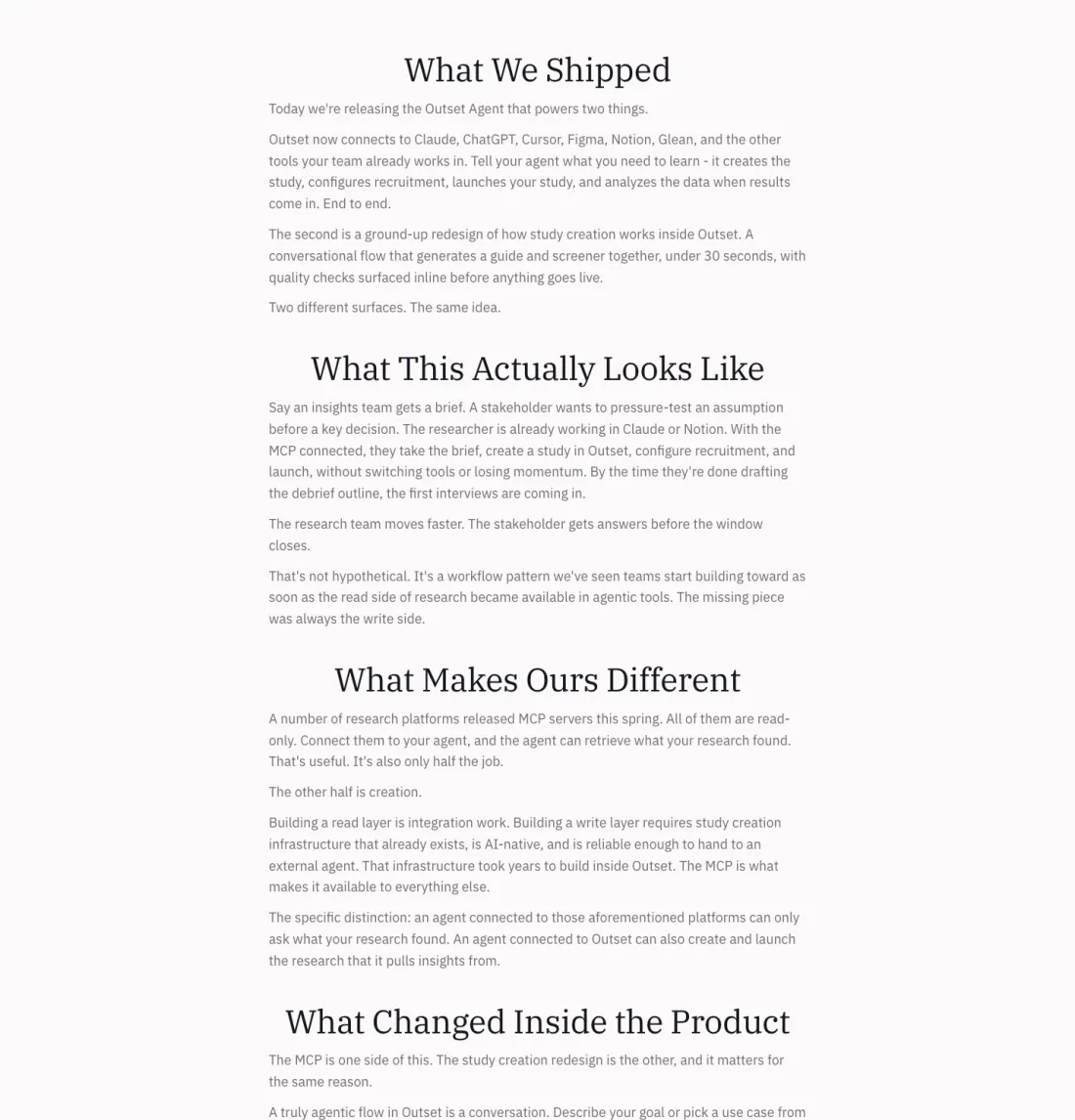
The thing they sell hardest is that it writes. From Claude you can create a study with sections, questions, screeners, display logic and quotas, configure recruitment with a sample size and a reward, launch it, then query reports, answers, topline insights and highlight clips. Twins are reachable the same way. The post says outright: “This distinguishes Outset from competitors whose MCPs are read-only.” I’ve spent a lot of this year on our MCP, so I read that sentence twice.
What can’t I see? There’s no static tool list published, the only guidance is that “the live tools/list response is the source of truth”, and without an account I can’t call it. There’s no price anywhere either. The pricing page says “Our pricing is not one-size-fits-all” and offers Get custom pricing.
One third-party guide (userintuition.ai) reports around $20,000 per seat per year from buyer references. I couldn’t corroborate that anywhere, so take it as a rumour. And twin accuracy is caveated but never quantified on any public page. NN/g’s study of the wider category found synthetic users capture general trends but miss the magnitude and the variability, with a standard deviation “consistently lower than the standard deviation in the human data”. That’s the thing I’d check in any digital twin user research: whether the twins agree with each other more than the people did.
What we built the same night
We didn’t build twins. Usero’s AI user tests are an agent driving a real browser through your product, and earlier this year we decided not to sell a language model playing a persona. If there’s no browser session behind the opinion, there’s no replay and no bug, so nothing to turn into a PR. Outset’s twin is the best-built version of that idea I’ve seen. It’s still not the thing we sell.
What I took from them is smaller: show the quotes under every answer, and let an agent write. Our MCP already exposed user tests, sessions and runs, but get_user_test_session returned a 2,000-character transcript excerpt, and there was no way for an agent to ask a study a question across participants.
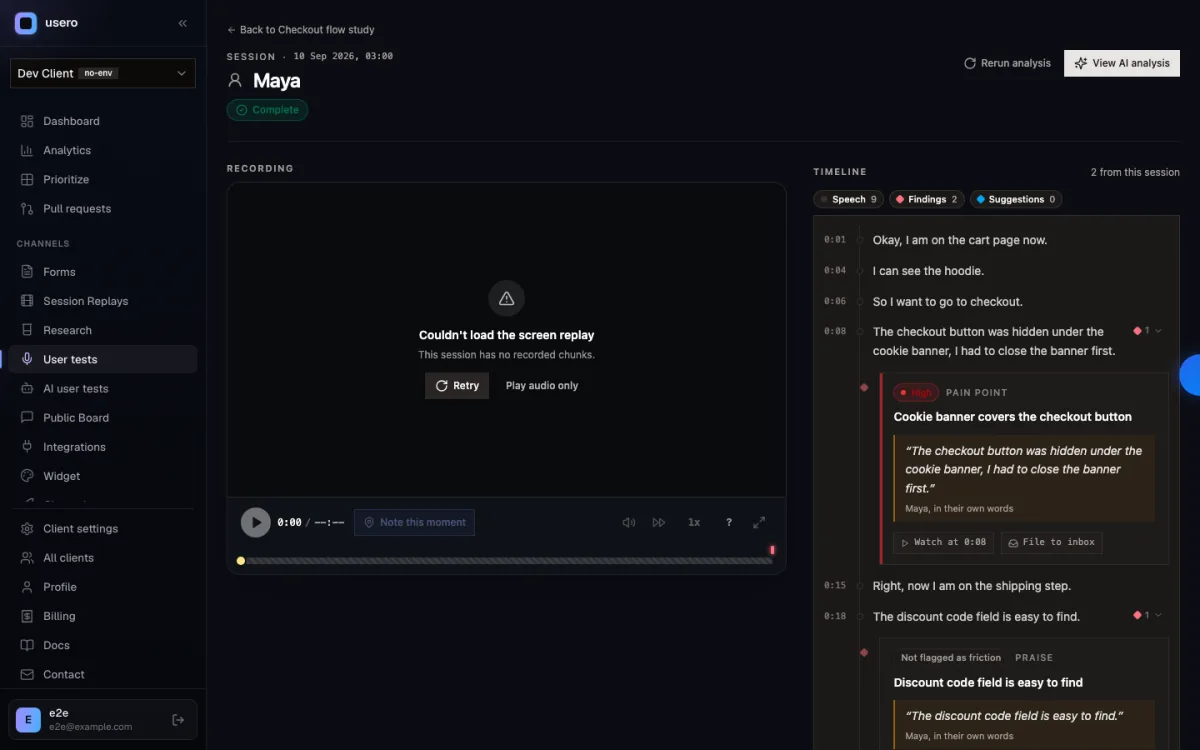
So tonight there’s a new tool, search_user_test_transcripts. An agent in Claude Code or Cursor asks a user-test study “what did participants say about checkout?” and gets back per-participant verbatim transcript segments with timestamps, the insights already filed from those sessions with their quotes, and a replay link that opens at the moment the words were said.
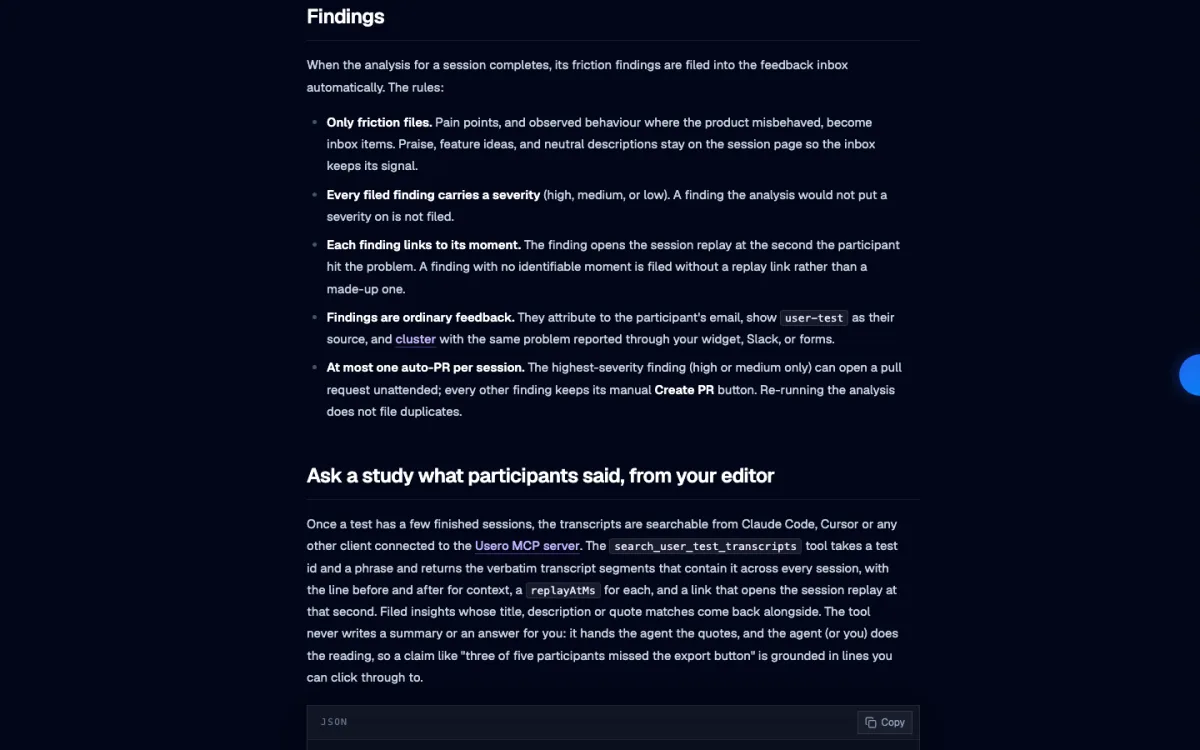
No generated answer. No confidence score either, since nothing in the response was generated. The agent in the editor does the summarising, and every claim it makes can be traced back to a timestamp. Same as Outset showing the quotes under a twin’s answer, except there’s no twin.
Here is a real call against a local dev server with a seeded study, trimmed to the first session’s first two hits and one insight.
{
  "testId": "ut_loop_checkout",
  "testTitle": "Checkout flow study",
  "query": "cookie banner",
  "sessionsSearched": 3,
  "sessionsWithHits": 2,
  "totalHits": 4,
  "sessions": [
    {
      "sessionId": "uts_loop_a",
      "tester": "Maya",
      "status": "completed",
      "sessionUrl": "http://localhost:5260/dev-client/user-tests/ut_loop_checkout/sessions/uts_loop_a",
      "transcriptHits": [
        {
          "text": "So I want to go to checkout.",
          "startSeconds": 5.1,
          "endSeconds": 7.4,
          "replayAtMs": 6600,
          "replayUrl": "http://localhost:5260/dev-client/user-tests/ut_loop_checkout/sessions/uts_loop_a?at=6600",
          "context": true
        },
        {
          "text": "The checkout button was hidden under the cookie banner, I had to close the banner first.",
          "startSeconds": 7.4,
          "endSeconds": 13.8,
          "replayAtMs": 8900,
          "replayUrl": "http://localhost:5260/dev-client/user-tests/ut_loop_checkout/sessions/uts_loop_a?at=8900",
          "context": false
        }
      ],
      "insights": [
        {
          "type": "pain_point",
          "title": "Cookie banner covers the checkout button",
          "severity": "high",
          "quote": "The checkout button was hidden under the cookie banner, I had to close the banner first.",
          "replayAtMs": 8900
        }
      ],
      "hitCount": 2
    }
  ]
}
get_user_test_session also grew a full-transcript option, so an agent can read the whole session instead of the first 2,000 characters.
It’s a narrow slice, one tool and one flag. No study-level report across participants yet, no hedge-triggered follow-ups in the widget, no PII flag on incoming feedback. Those are the next three, in that order.
What would I steal next? The changelog format, first. A dated page with one noun per entry told me more about the company than the logo wall did, and we sell a changelog to customers without publishing one of our own. Then the human grading the AI’s summary of their own words. If the person who left the feedback can mark our summary of it, we find out when the AI got it wrong, and they hear back from us.
The twins stay on the parked ideas list. I’m still curious what a room of them says when the real people disagree, though.
Frequently Asked Questions
What is an Outset Digital Twin?
In Outset’s words, a twin gives "directional answers in minutes, validated against the real person behind them". Every twin starts from one human: you recruit a custom audience, each person sits a long Grounding Interview, and the twin is trained on that transcript. Each twin answer carries a High, medium or low confidence score, the human quotes that informed it are shown underneath, and the participant grades their own twin. Follow-up interviews keep it current.
How does Outset’s AI interviewer decide when to ask a follow-up?
Their blog post on the interview mechanism says follow-ups fire on linguistic cues: vagueness, sentiment, enthusiasm level and hedging language, with "maybe" and "I’m not really sure" as the examples. Follow-ups are grounded in researcher-configured instructions, and the moderator does not evolve during a study, so every participant gets the same interviewer. The depth setting is called Abyss mode, up to 10 follow-ups per question.
What can the Outset MCP do?
Outset Agent is a remote MCP at api.outset.ai/mcp using OAuth 2.1 with PKCE and dynamic client registration, listed for Claude, ChatGPT, Cursor, Figma, Notion, Glean and Microsoft Copilot. It writes: from Claude you can create a study with sections, questions, screeners, display logic and quotas, configure recruitment, launch it, then query reports, answers, topline insights and highlight clips. Twins are reachable the same way. There is no published tool list; the live tools/list response is the source of truth.
How is Usero’s search_user_test_transcripts different from a twin?
It generates nothing. An agent in Claude Code or Cursor asks a user-test study a question and gets back per-participant verbatim transcript segments with timestamps, the insights already filed from those sessions with their quotes, and a replay link that opens at the moment the words were said. There is no synthetic participant and no confidence score, because nothing in the response was generated. The agent in the editor does the summarising, and every claim traces back to a timestamp.
Continue reading
How Canny and Featurebase Carry Customer Demand to the Engineering Ticket, and How We Built Ours
Canny shows voters, companies and MRR on a post, but every tracker integration is on Pro and the docs only describe a link on the issue. Featurebase’s Jira panel shows votes live, and its Copy as prompt includes the author’s email. We built a Demand block for issues and AI pull requests: companies, MRR, must-haves and two voter quotes for Linear, Jira and private repos, counts only for public GitHub repos, no emails ever.
6 min read
How Canny Groups Votes by Company, and How We Built Ours
Canny’s “Show votes grouped by company” request has 198 votes and was marked complete in August 2026 by pointing at a new Ideas view. We tested where Canny and Featurebase show the company behind a vote, then built a company count, a Most companies sort and a grouped voter list.
7 min read
How to Recruit Participants for User Research Without a Panel
Recruit participants for user research by writing a behavioural screener and working through sources cheapest first: your own users, their communities, referrals from people close to them, then a paid panel. How many to recruit, what to pay, and how to run a referral round without paying for junk sign-ups.
6 min read
Build a feedback loop your team actually uses
Usero collects, clusters, and turns user feedback into shipped fixes.
Get started free