How Canny and Featurebase Carry Customer Demand to the Engineering Ticket, and How We Built Ours
“The current Linear integration only provides a link, but engineers have no idea what it’s about without accessing Featurebase.” That’s a Featurebase customer on Featurebase’s own feedback board, October 2025.
A ticket that just says “SAML SSO” is up against fifty other tickets on gut feel. Add “14 votes from 6 companies, $4k MRR, 5 say must have” and the engineer knows why it matters without asking anyone. Canny and Featurebase both sell their tracker integrations on this. Featurebase’s GitHub card says “keep engineering in sync with customer needs”.
I wanted to see how much of that demand makes it onto the Jira, Linear or GitHub ticket. We poked around both admin panels on test workspaces and read the docs for the parts we couldn’t install. Then we built our own.
Where does Canny keep the demand?
Inside Canny, and it’s pretty good. Our test post, “Export my saved lift lines as GPX”, has 3 votes and $6.2k on the card.
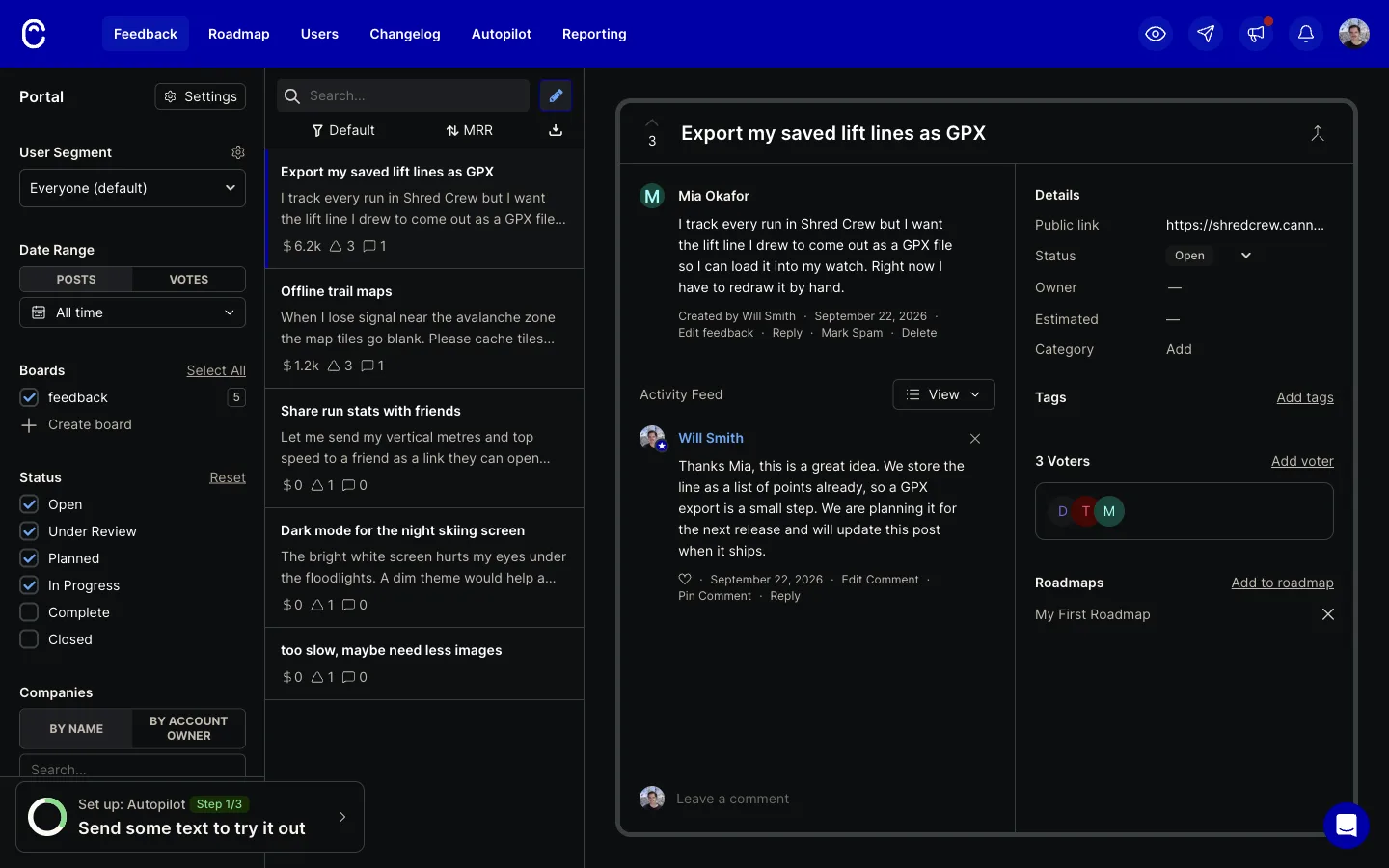
Click the voters and you get “Dana Reyes at Example Co”, her monthly spend, a priority dropdown, and a $6,200/MO total at the bottom. That’s pretty much what I’d want on a ticket.
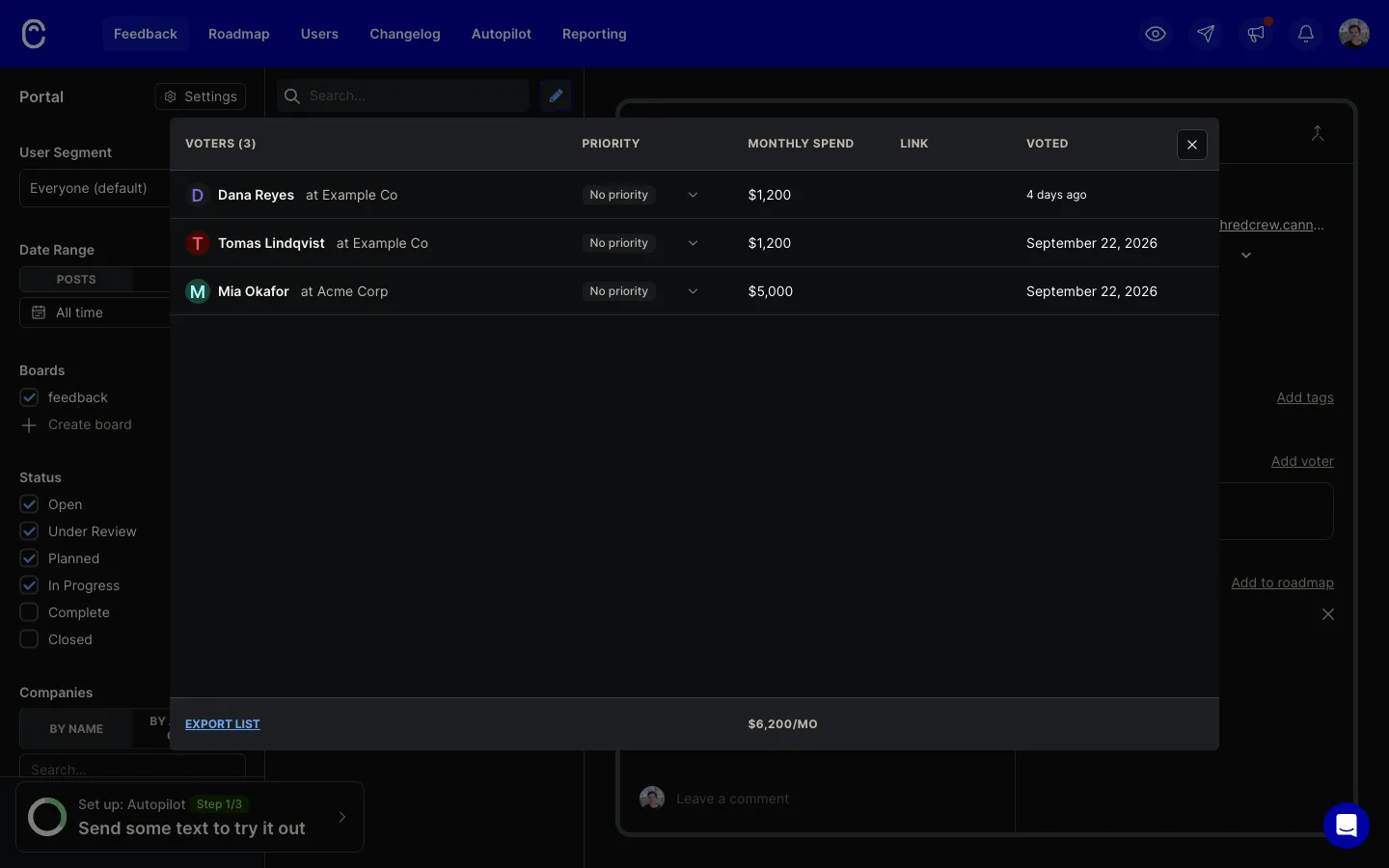
(Four days earlier this same post showed $0, because I’d linked the voters to their companies after they voted. In the last post I called that “frozen at vote time”. It has caught up since, I don’t know what triggered it, so “stale for a while after a company link” is fairer.)
How does it get to Jira?
On our Free workspace, it doesn’t. Settings, Integrations lists six project management tools (Asana, Azure DevOps, ClickUp, GitHub, Jira, Linear) and every one has a Pro badge.
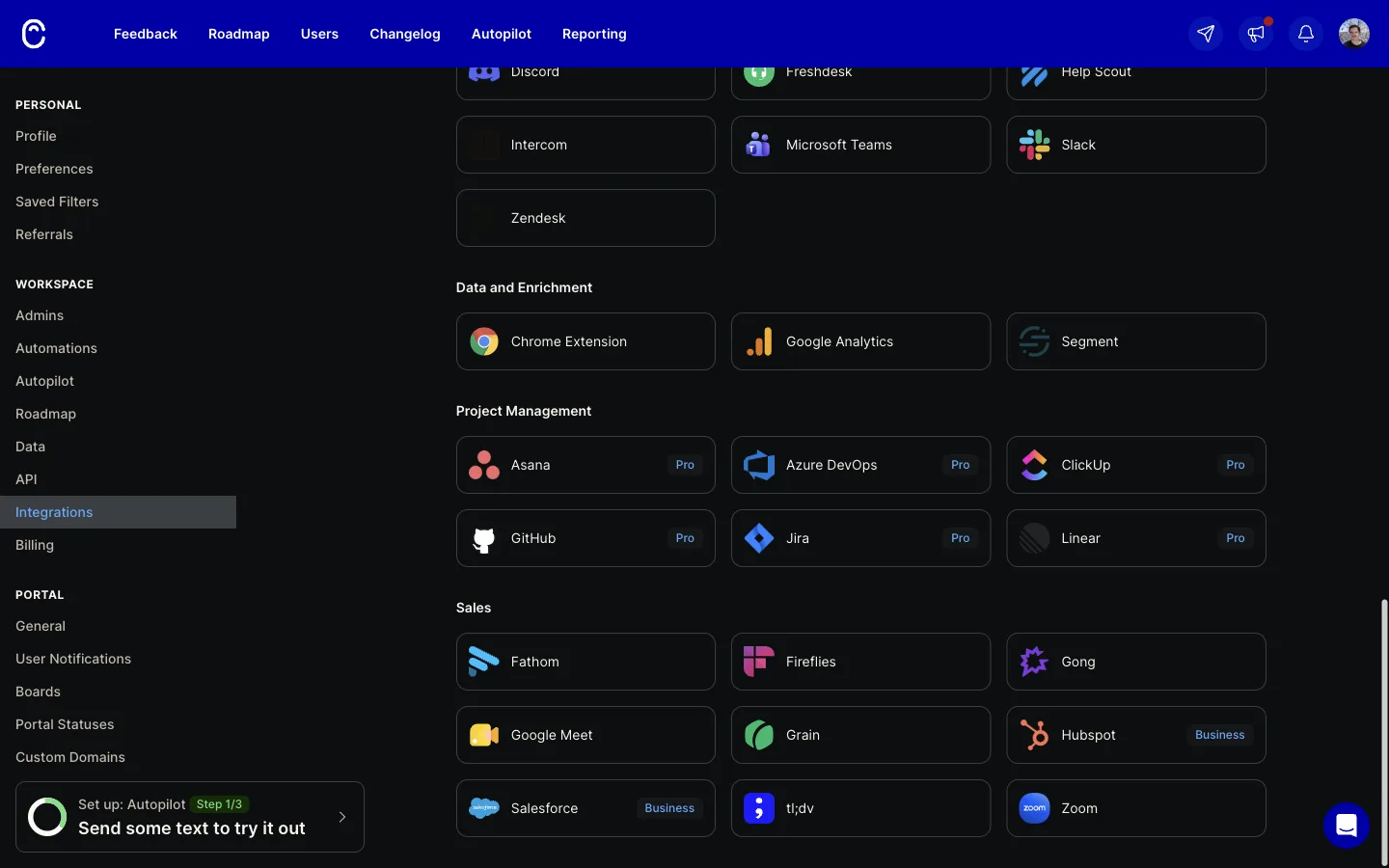
Opening Jira gets you a “Sync Canny posts to Jira” card with a 14-day trial button and nothing to install. Pro starts at $79 a month, billed yearly. So on Free you can see $6,200/MO on a post, but the only way to get it into a tracker is copy and paste.
We couldn’t try the Pro side, so this part is from Canny’s docs. With Pro the post gets a Linked issues section where you enter an issue key or create a new issue with a project, issue type, summary and description. Jira gets a “Canny Links” panel, and the Marketplace listing says “See which posts/issues are linked inside both Canny and Jira”. On legacy GitHub, the Canny bot leaves a comment on the issue linking back to the post.
None of those pages say votes, companies or MRR end up on the issue. That’s an absence in the docs, not something I watched fail, but every description is about linking and status. There are third-party Jira apps and Zapier templates whose whole job is getting vote counts into Jira.
The status sync is the good bit. For Ideas on Linear and Jira the docs say it runs both ways, so the engineer moves the ticket and the voters get told.
What about Featurebase?
Featurebase had Linear, Jira, ClickUp and GitHub ready to connect on our plan, with Azure DevOps behind an upgrade.
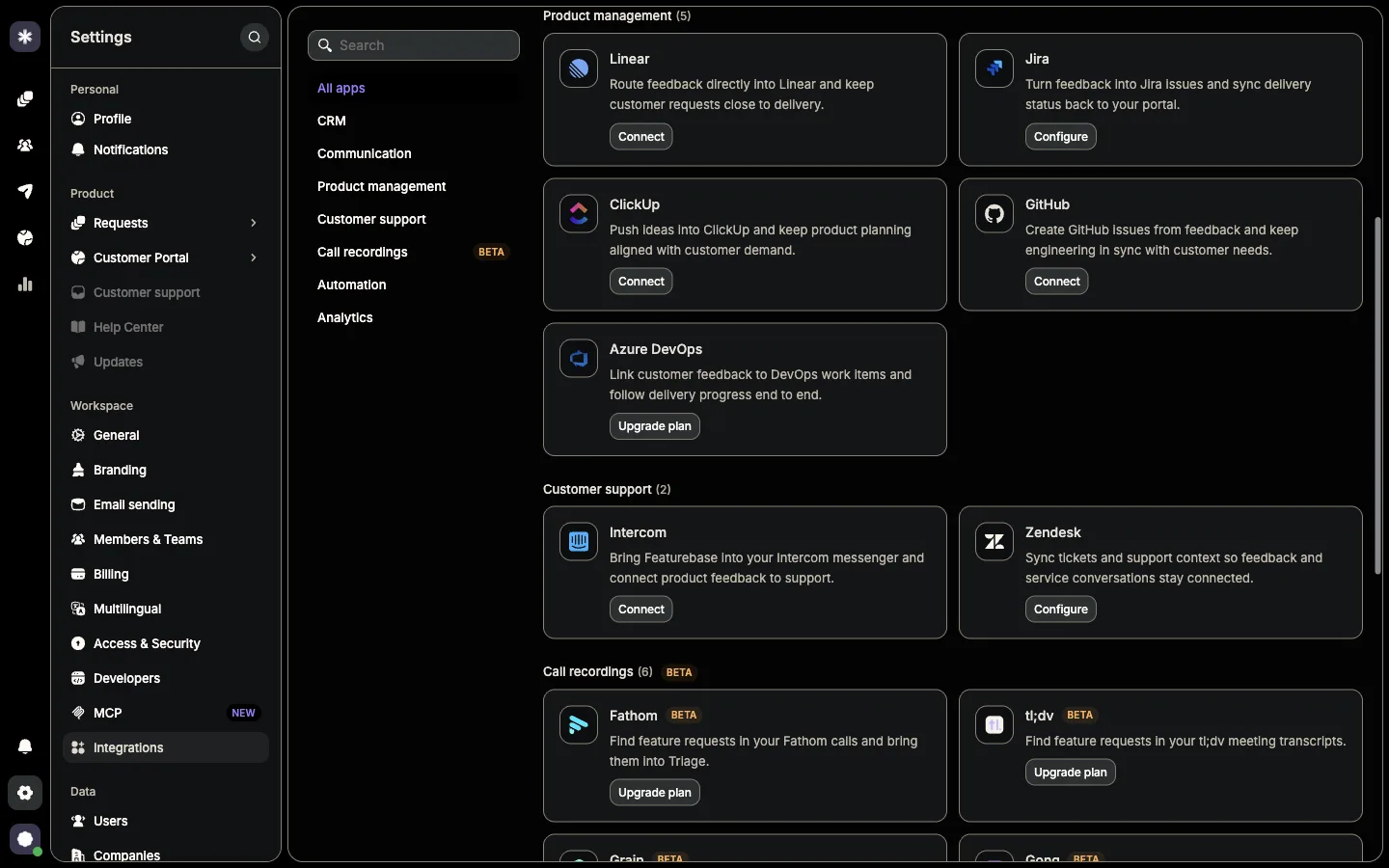
Jira is wired up from the Jira side. Configure opens a modal with one field in it, an API key to paste into the Featurebase for Jira app. Once linked, their docs say the Jira issue shows “the post’s info, like comments, votes, and similar posts”. It’s the only vote count on a ticket I found documented in either product, and because it’s read from Featurebase it never goes stale. I like that a lot. Companies and revenue aren’t mentioned.
For GitHub, Linear and ClickUp the help articles don’t say what goes in the issue body. Featurebase’s customers fill that gap in. The quote at the top is about Linear, and here’s another one from September 2026:
“Developers do not have Featurebase access. When feedback is sent to Linear, include the submitting customer’s email address and/or Featurebase user ID so the team does not need to copy it manually.”
Then there’s Copy as prompt. It sits in the request header next to Copy link and Merge, and copies the request as markdown to paste into an AI agent. Smart idea, a lot of the time the thing reading a request is an agent now. This is what it copied for our test request:
# Feedback request
- **Request:** SAML SSO for enterprise workspaces
- **Link:** https://compasscalendar.featurebase.app/p/saml-sso-for-enterprise-workspaces
- **Status:** In Review
- **Category:** Feature Request
- **Requesters:** 1
- **Author:** Will (Admin)
- **Created:** 03/08/2026, 23:39:09
## Description
Our security review blocks rollout until we can enforce SSO with Okta.
## Author details
- **Name:** Will
- **Type:** Admin
- **Email:** (my address, removed for this post)
## Comments (0)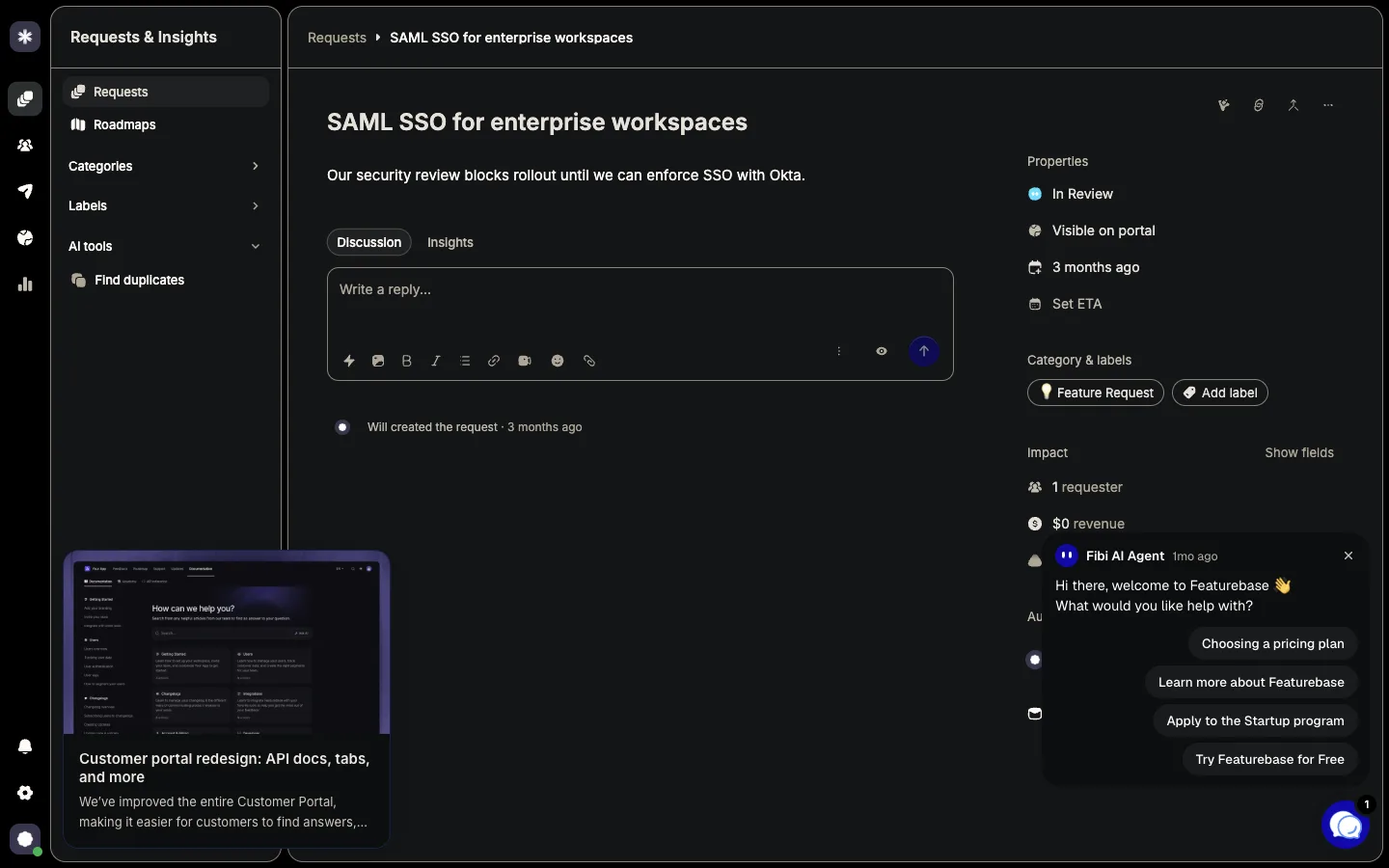
It has the requester count and the author’s email (I took mine out above), but no revenue or companies, even though the Impact panel right next to the button says “$0 revenue”. There’s no warning about the email either, and a blob made for pasting into an agent can easily end up in a public issue.
So what did we build?
Usero already had the data. Board votes carry a priority, voters resolve to a company (that was the last build), and people carry MRR. Now when you create an issue from a feedback item that has a linked board post with 2 or more votes, the body gets a Demand section.
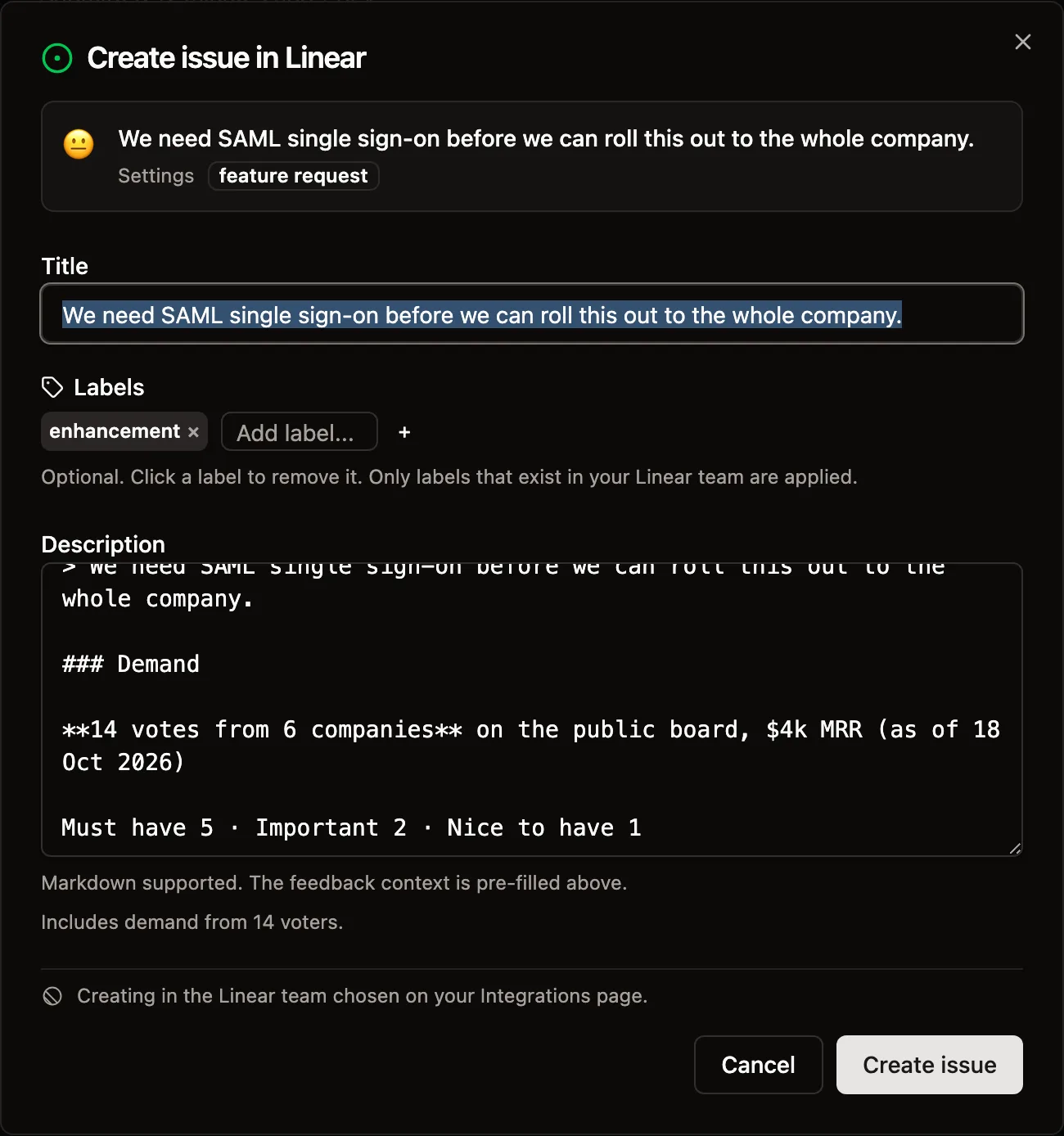
Linear, Jira and private GitHub repos get the full version. This is the Linear modal on our seeded SSO post:
And this is how the block renders once it’s on the issue:
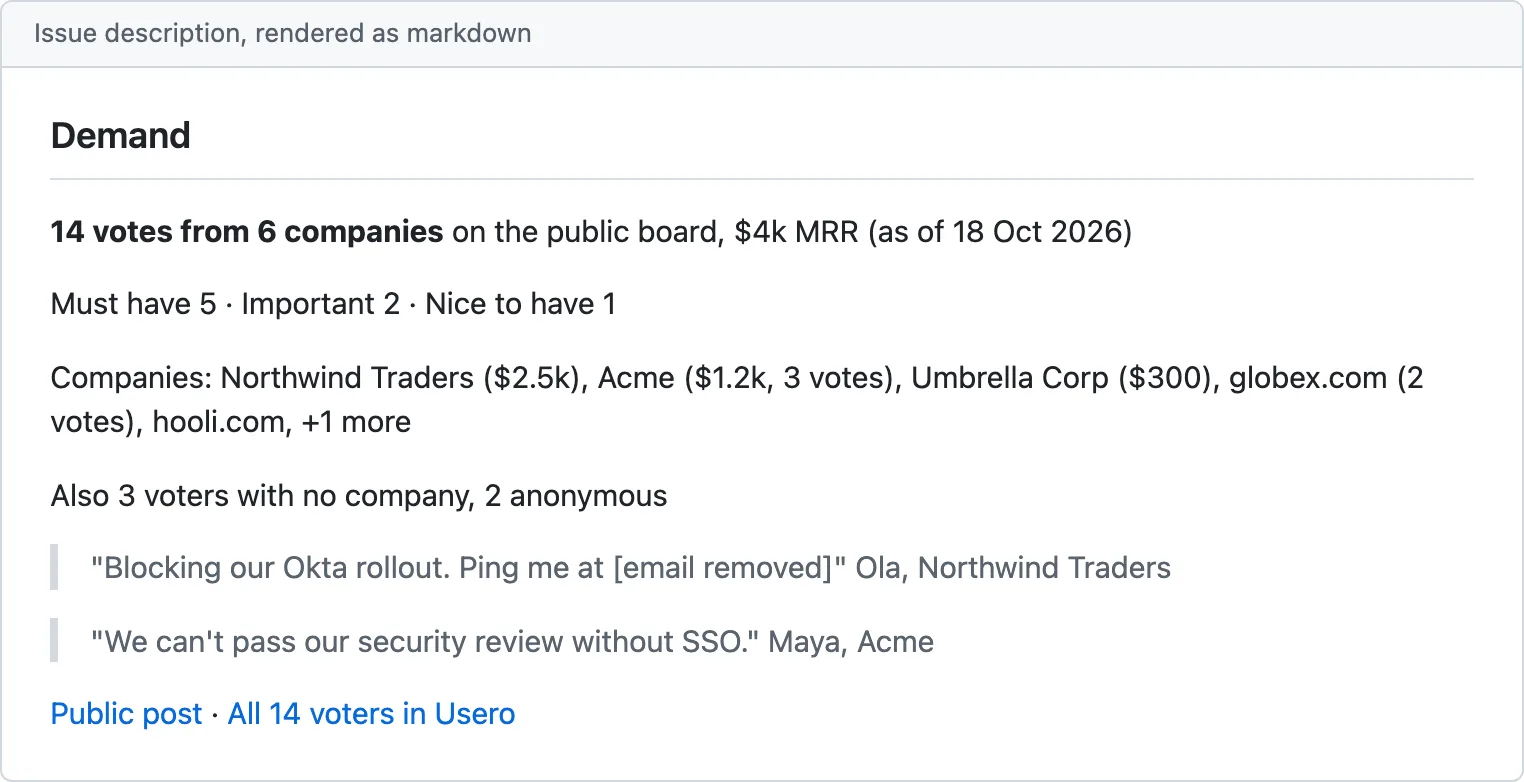
Companies are sorted by MRR then votes, five max, and MRR counts once per company like Canny does it. The two quotes are the latest voter comments, word for word, with a first name and company. No AI summary, and team replies don’t count.
No email addresses, ever. Ola put hers in her comment in our seed data, and it comes out as “[email removed]”. If the engineer wants to know exactly who asked, “All 14 voters in Usero” opens the list.
Public GitHub repos get a lot less. A company name in a public issue tells everyone that company is your customer, and they may not want that out there. MRR, even added up, is your revenue. GitHub keeps edit history too, so deleting it later doesn’t take it back. On a public repo it’s counts only: the vote count, which is already public on the board, the company count, which names nobody, and a team-only link to the rest.
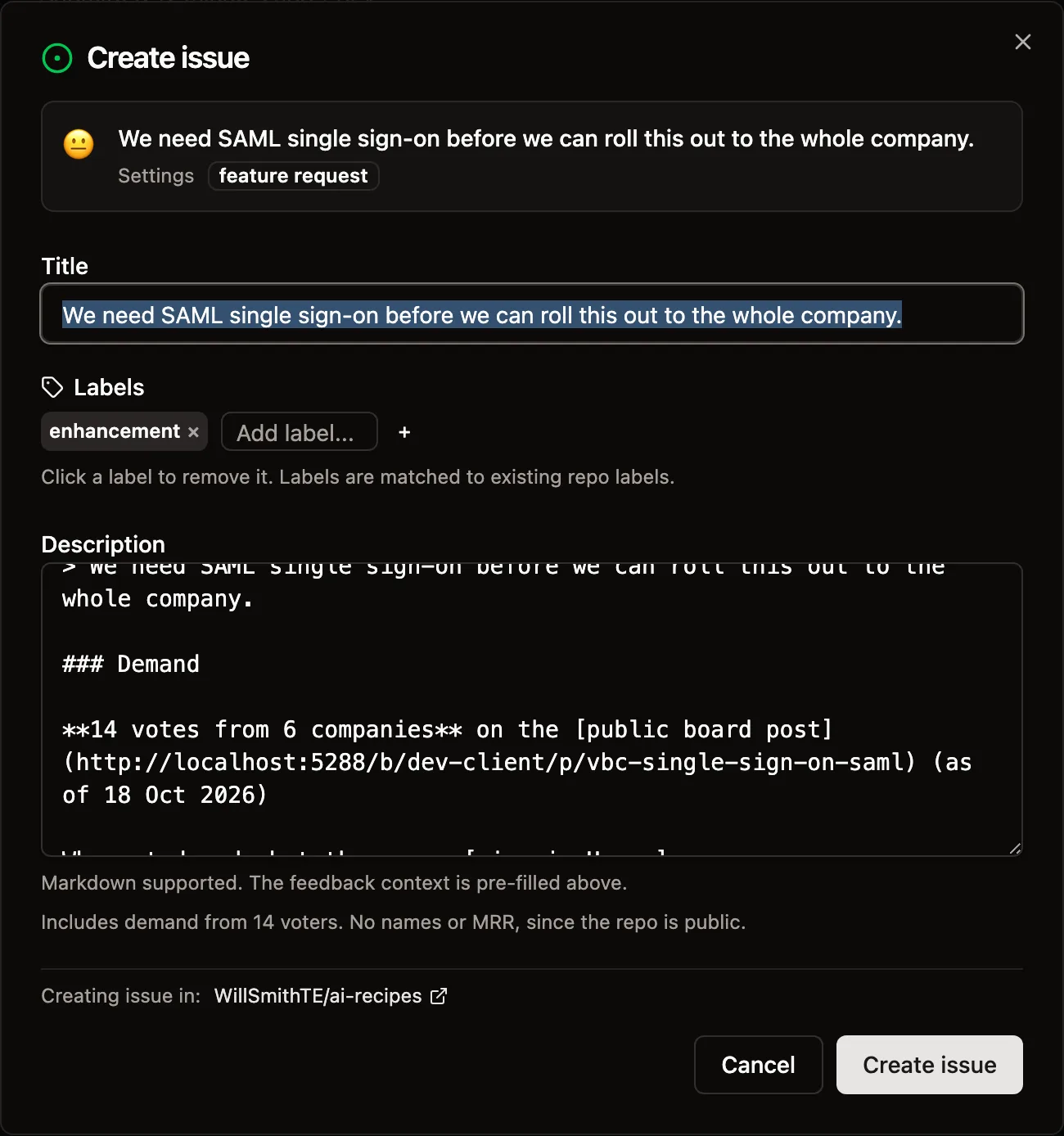
We check visibility through the GitHub App, and if that lookup fails the repo counts as public. The modal tells you which version you’re getting. AI pull requests get the same block, decided by the repo the PR is opened in. The MCP create_issue tool has a demandDetail option that can cut it down to counts or nothing, but never add more.
What’s missing?
It’s a snapshot. Each block carries an “as of” date so an old number at least looks old. Featurebase’s live Jira panel is better here. The next step is refreshing the block in place, rewriting just that section when the votes change. GitHub and Linear edits are quiet, but Jira emails watchers on every edit, so Jira should probably only refresh when something big moves, like a new company. And never as a comment. Canny’s own board has a Linear request saying a comment every time a post is linked “sends distracting notifications”.
The other one is a setting per integration (Full, Counts only, Off) for teams who want less detail in Linear, or more in a public repo they’re fine sharing. For now the defaults are all you get.
I’m curious which line engineers read. My guess is the must-have split and the quotes do more work than the MRR, but we’ll see once it’s on real tickets.
Continue reading
How Canny Groups Votes by Company, and How We Built Ours
Canny’s “Show votes grouped by company” request has 198 votes and was marked complete in August 2026 by pointing at a new Ideas view. We tested where Canny and Featurebase show the company behind a vote, then built a company count, a Most companies sort and a grouped voter list.
7 min read
How to Recruit Participants for User Research Without a Panel
Recruit participants for user research by writing a behavioural screener and working through sources cheapest first: your own users, their communities, referrals from people close to them, then a paid panel. How many to recruit, what to pay, and how to run a referral round without paying for junk sign-ups.
6 min read
Jira Customer Feedback: Get User Requests Into Jira With the Customer Attached
How teams that live in Jira handle customer feedback today (pasting by hand, Jira Service Management, Jira Product Discovery, Canny or Featurebase status rules), what a Jira feedback integration should do, why status category beats a mapping grid, and how Usero creates Jira issues from feedback and syncs status both ways.
6 min read
Build a feedback loop your team actually uses
Usero collects, clusters, and turns user feedback into shipped fixes.
Get started free